For several years, donors – ECHO, USAID, AFD, World Bank, European Union – have been tightening their requirements on a point that has become strategic: due diligence on NGO partners. For CFOs, compliance officers and program directors, this exercise is no longer an administrative formality. It determines access to funding, audit success, and the sustainability of projects implemented in the field. Yet in a context where aid localization pushes organizations to work with more national and local actors, the volume of due diligence explodes and artisanal methods (spreadsheets, paper files, emails) reach their limits.
In this guide, we go deep into what effective partner due diligence looks like in 2026, what donors concretely expect, the risks of an inadequate approach, and an actionable methodology in seven steps. We will also see how a platform like Abvius – designed for NGOs, CSOs and international solidarity organizations – can structure this work, secure the audit trail and smooth dialogue between headquarters and the field.
Partner Due Diligence for NGOs: why it is redefining compliance in 2026
Reading time: ~14 min
Table of Contents
- Why partner due diligence has become essential
- Regulatory framework and donor expectations
- The 7 pillars of solid partner due diligence
- The risks of insufficient due diligence
- Methodology: conducting effective due diligence
- How Abvius structures partner due diligence
- Best practices and implementation steps
- Mini FAQ
1. Why partner due diligence has become essential
Partner due diligence refers to all the verifications – legal, financial, operational, ethical – that an NGO or CSO conducts before, during and after a partnership with a local organization, a service provider or a sub-recipient. Historically, it was limited to a few checks before a grant agreement. Today, it has become a continuous, documented, auditable process required by almost all institutional donors.
Several dynamics converge to explain this change. First, the localization agenda resulting from the Grand Bargain pushes international NGOs to transfer more resources and responsibilities to local actors. This mechanically increases the number of partners to assess and monitor. Second, scandals involving embezzlement, fraud, influence trafficking or violation of international sanctions have led donors to strengthen their requirements for internal control and due diligence. Finally, the geopolitical environment – conflicts, sanctions, terrorist risk zones – requires heightened vigilance on the identity, governance and financial flows of partners.
For an NGO CFO, the question is therefore no longer whether to conduct due diligence, but how to scale it without sacrificing quality, without slowing operations and without creating a bureaucratic barrier that would discourage small local actors. This is precisely the equation we will solve in the sections that follow.
2. Regulatory framework and donor expectations
Before discussing tools and methodology, it is essential to understand what the main institutional donors concretely expect. The rules differ, but a common foundation emerges: rigorous identification, counter-terrorism and anti-money laundering checks, assessment of financial capacity, control of management systems, and continuous monitoring.
Key requirements by donor
Here is a synthetic comparison of the expectations of the main donors in terms of partner due diligence:
| Donor | Main Requirement | Required Documents | Review Frequency |
|---|---|---|---|
| ECHO (EU) | Capacity Assessment and sanctions checks | Capacity Assessment, financial statements, internal policies | Before each agreement + annual review |
| USAID | Pre-award survey and NICRA | Audit reports, procedure manuals | Before contracting + quarterly monitoring |
| AFD | Assessment of institutional capacity | Articles of association, certified accounts, anti-fraud policy | Before agreement + monitoring for project duration |
| World Bank | Financial Management Assessment | Financial management plan, external audit | Before disbursement + semi-annual review |
| United Nations (OCHA/UNDP) | HACT – Harmonized Approach to Cash Transfers | Micro-assessment, spot checks, audits | Every 5 years + regular checks |
This table does not cover all regulatory subtleties, but it illustrates an essential point: each donor has its own framework and its own vocabulary. An NGO working with multiple donors must therefore be able to produce, on demand, standardized and traceable documentation. This is where data centralization becomes decisive.
Sanctions lists and counter-terrorism vigilance
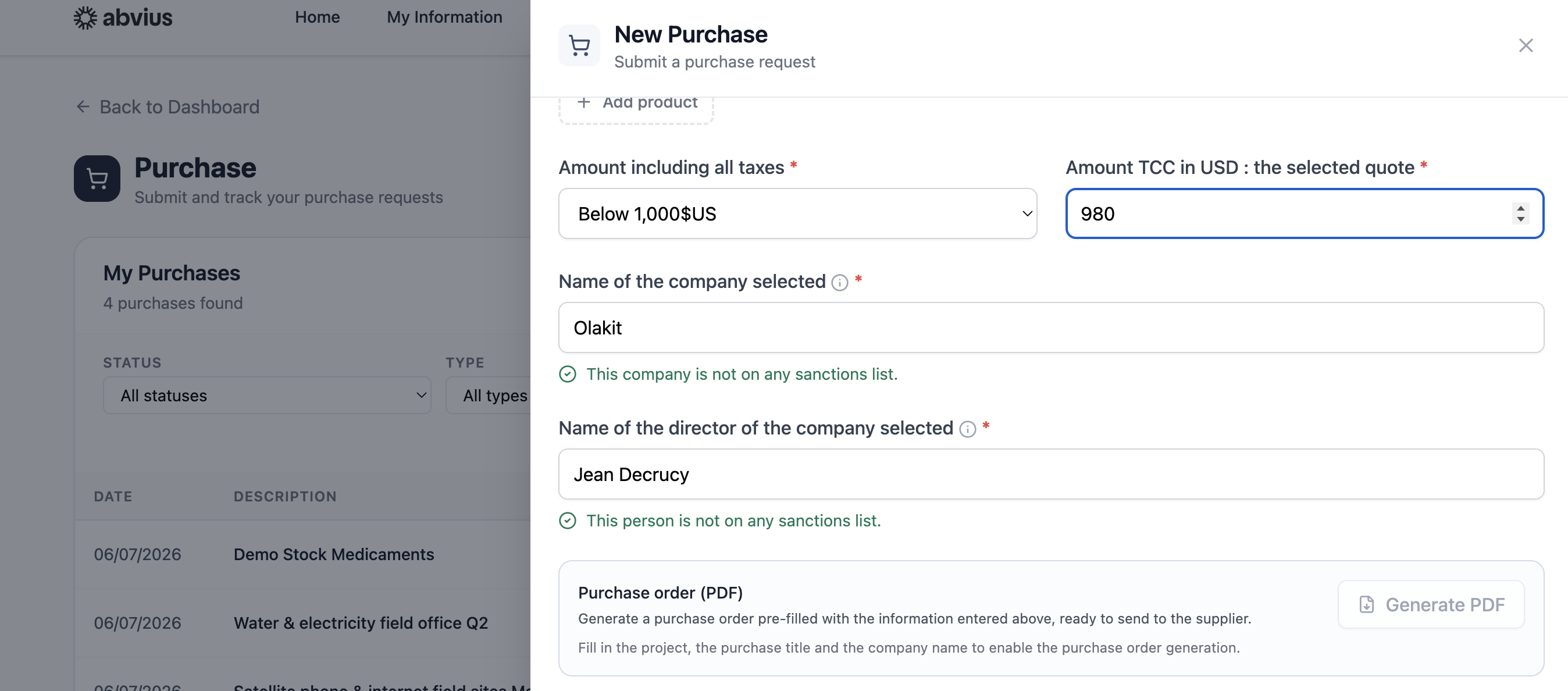
To these contractual requirements is added a transverse obligation: screening against sanctions lists. Whether it is the US OFAC list, the consolidated lists of the European Union, or the UN lists, no NGO can disburse funds to an entity or person on these lists. This screening must be performed before each contract and updated regularly, as the lists evolve constantly. Penalties for non-compliance can amount to full restitution of funds and exclusion from future financing.
3. The 7 pillars of solid partner due diligence
Beyond donor-specific requirements, a mature due diligence approach rests on seven dimensions that must be systematically covered. Neglecting them exposes you to blind spots that will inevitably appear during audit.
3.1 Legal identity and governance
The first pillar consists of verifying that the partner exists legally, that it has valid registration in its country, and that its governance complies with its bylaws. This involves collecting official documents (bylaws, registration certificate, tax number), but also analyzing the composition of the board of directors and the identity of beneficial owners. This is also where potential conflicts of interest are identified.
3.2 Financial health and accounting capacity
The second pillar aims to ensure that the partner has a reliable accounting system, produces annual financial statements, and is able to absorb project funds without risk of cash flow disruption. The review includes double-entry bookkeeping, the presence of an external auditor, and the capacity to provide line-by-line budget tracking.
3.3 Internal controls and segregation of duties
The third pillar examines the robustness of internal procedures: segregation of commitment, validation and payment functions, existence of delegation thresholds, procurement rules, traceability of decisions. This is one of the pillars most often deficient in small local structures, but also one of the easiest to strengthen through mentoring and tooling.
3.4 Ethics, anti-fraud and safeguarding
The fourth pillar covers anti-fraud, anti-corruption, anti-harassment and beneficiary safeguarding (PSEA) policies. Donors expect each partner to have a signed code of conduct, a reporting mechanism, and an identified point of contact. The absence of these elements is now disqualifying for most institutional funding.
3.5 Operational capacity and field presence
The fifth pillar assesses the partner's capacity to effectively implement planned activities: available human resources, technical expertise, experience on similar projects, geographic coverage. A financially sound partner but incapable of operating in the target zone represents a risk as significant as a partner weak on accounting.
3.6 Data protection and information security
The sixth pillar, often underestimated, concerns the management of beneficiary data. With the entry into force of regulations like GDPR and equivalent national frameworks, NGOs must ensure that their partners respect minimum security standards: encrypted storage, restricted access, deletion procedures, supervised transfers. This pillar is increasing in importance in contexts where collected data could endanger beneficiaries.
3.7 Compliance with sanctions and counter-terrorism
The seventh pillar is systematic verification against sanctions lists, already mentioned above. It must cover the organization, its leaders, and ideally its main economic beneficiaries. This verification must be documented, dated, and reproducible – in other words, in case of audit, you must be able to prove when, how, and by whom it was performed.
4. The risks of insufficient due diligence
Sloppy or non-existent due diligence is not just an administrative weakness: it exposes the NGO to major, sometimes existential risks. Understanding these risks allows investing in proper infrastructure instead of suffering the consequences later.
- Direct financial risk: donors can demand restitution of disbursed amounts if due diligence was not conducted properly. In some cases, these amounts reach hundreds of thousands of euros per project.
- Reputational risk: a scandal involving a local partner can cause lasting loss of confidence from both private and institutional donors, with impact across multiple budgetary periods.
- Operational risk: suspension of an ongoing project following discovery of irregularities with a partner leaves beneficiaries without support and weakens the entire consortium.
- Legal risk: in some countries, NGO leaders may be held personally liable if the partner is involved in terrorist financing or money laundering.
- Exclusion risk: several major donors apply a blacklisting policy that can prevent access to their financing for several years.
These risks are not theoretical. Every year, NGOs see major contracts suspended or not renewed because of weaknesses in their due diligence chain. The issue is therefore not to "do as best you can" but to structure the approach as a permanent, tooled and auditable process.
5. Methodology: conducting effective due diligence
Now let us move to practice. Here is a five-phase methodology, adapted to the realities of medium to large NGOs, and compatible with the requirements of the main donors. It can be deployed manually at first, then progressively scaled within an integrated platform.
Phase 1: Structured information collection
The first phase consists of sending the partner a standardized questionnaire and collecting a defined set of supporting documents. This questionnaire must cover the seven pillars described above, while remaining proportionate to the partner's size and the intended amount. For a small local association receiving less than 50,000 euros, a streamlined version is preferred. For a major sub-recipient managing several million, a complete version with verification interviews is used.
Phase 2: Analysis and scoring
The collected information must be analyzed according to a shared scoring matrix. Each pillar receives a score, which is weighted according to its relative importance. The overall score determines the risk level and the type of support measures to provide: enhanced monitoring, disbursement caps, additional controls, capacity-building plan. The objective is not to exclude fragile partners, but to calibrate the level of control based on actual risk.
Phase 3: Validation and contracting
The third phase covers hierarchical validation of due diligence and its contractual formalization. The report must be signed by a compliance manager, archived with timestamp, and referenced in the sub-grant agreement. Contract clauses must reflect identified points of concern (surprise audits, enhanced reporting, fund restitution in case of breach).
Phase 4: Continuous monitoring and periodic reviews
Due diligence is not a one-time event. During the partnership, periodic reviews must be organized – typically annually, or more frequently for high-risk partners. These reviews are based on operational and financial indicators, external audit reports, and field visits. Any alert must be documented and addressed within a defined timeframe.
Phase 5: Closure and lessons learned
The final phase occurs at partnership closure. It consists of producing an assessment that feeds the organization's knowledge base: strengths, difficulties encountered, recommendations for any future partnership. This lessons-learned exercise is valuable when rapidly assessing an already-known partner in a new funding opportunity.
6. How Abvius structures partner due diligence
At Abvius, we have designed the first Finance, Operations and MEAL platform specifically for NGOs, CSOs and international solidarity organizations. Partner due diligence is one of the processes we help scale without losing the finesse and humanity that make a partnership valuable. Here is how we concretely intervene.
First, we offer centralization of partner files. Each partner has a single record where legal documents, assessments, scores, review histories and supporting documents converge. No more files scattered between an Excel spreadsheet, an email inbox and a shared server: everything is available from a single interface, accessible to both headquarters and field teams, with granular access rights.
Next, our platform integrates configurable validation workflows: you define approval steps, responsible parties at each level, and conditions for moving from one stage to the next. Every action is timestamped and attributed to an identified user. This automatically generates a complete audit trail, required by almost all institutional donors.
We also offer electronic signature of partnership agreements and compliance reviews, directly integrated into the process. This simplifies document collection from sometimes distant partners, while guaranteeing the legal value of the signature and its traceability.
On the financial side, real-time budget monitoring allows continuous alignment of commitments, disbursements and partner reports. Any alert (overspend, variance, delay) automatically escalates to the responsible party. Combined with our automatic donor reporting module, this significantly reduces time spent preparing for audit or responding to donor information requests.
Finally, headquarters-field centralization smooths dialogue with local partners. These partners can, depending on their access rights, directly enter supporting documents, complete due diligence questionnaires, and check their disbursement progress. This reduces email back-and-forth and strengthens mutual trust.
To learn more about our approach and explore how Abvius can integrate with your existing processes, we invite you to visit https://abvius.org.
Comparison: traditional tools vs Abvius
| Function | Paper / email | Excel spreadsheets | Abvius |
|---|---|---|---|
| File centralization | Scattered | Partial | Unique and shared |
| Audit trail | Difficult to reconstruct | Depends on file history | Automatic and timestamped |
| Validation workflow | Via email | Non-existent | Configurable by role |
| Agreement signature | Scanned, unreliable | Outside system | Electronic integrated |
| Donor reporting | Manual, lengthy | Manual, error-prone | Automated, by donor |
7. Best practices and implementation steps
Do you want to strengthen your NGO partner due diligence approach? Here are five actionable steps to move from artisanal existing practices to a structured process in just a few months.
Step 1: Map the current state
Start by inventorying active partners, documents already collected, and processes in place. This mapping often reveals blind spots: partners without recent review, incomplete files, informal validations. It is the foundation for building a realistic upgrade plan.
Step 2: Formalize a due diligence policy
Write – or update – an internal policy on partner due diligence that clearly defines thresholds, pillars, responsibilities and review frequencies. This policy must be validated by leadership and shared with all concerned teams, from headquarters to the field.
Step 3: Standardize tools and templates
Deploy standardized questionnaires, scoring grids, report templates and checklists. The objective is for two teams working in different countries to produce comparable due diligence, so data flows to headquarters in a coherent manner.
Step 4: Tool the approach
Once the number of partners exceeds about ten, generic tools show their limits. Adopt a specialized platform that centralizes files, orchestrates workflows, manages electronic signature and automatically generates the audit trail. This is when Abvius can deliver significant time and reliability gains.
Step 5: Train teams and measure performance
A policy and tool are not enough: teams must be trained, not only on procedures but also on ethical and regulatory issues. Then measure your approach's performance with simple indicators: rate of current files, average validation time, number of alerts closed on schedule. These indicators will be valuable at your next donor review.
8. Mini FAQ
Do I need to perform due diligence on all partners, even small ones?
Yes, but with a proportionate approach. For very small partners or modest amounts, a streamlined version of the questionnaire and a sanctions list check are generally sufficient. The important thing is never to skip the formal verification step, because it is precisely on the "small cases" that audits identify the biggest gaps.
How often should I update a partner's due diligence?
The standard is a complete annual review, supplemented by event-driven updates: change of leadership, significant change in scope of activities, internal alert, or new donor requirement. For partners classified as high-risk, semi-annual review is recommended.
How do I reconcile rigorous due diligence with the localization agenda?
These two objectives do not oppose each other. Intelligent due diligence is also a capacity-building tool: it identifies gaps, proposes an improvement plan and enables local partners to progress. Over time, this consolidates a network of solid local actors capable of directly accessing institutional funding. The issue is therefore to make due diligence a lever for empowerment, not an obstacle.
Is electronic signature accepted by donors for partnership agreements?
Yes, almost all institutional donors now recognize electronic signature, provided it meets a reliable identification standard (typically eIDAS in Europe). It is a valuable tool for accelerating contracting with distant partners while guaranteeing legal security.
Conclusion
NGO partner due diligence is no longer a formality: it is the foundation of solid compliance, a relationship of trust with donors, and aid localization that works. By structuring your approach around the seven pillars, adopting a five-phase methodology and tooling it all with a specialized platform, you transform a regulatory constraint into an operational advantage. At Abvius, we guide NGOs and CSOs through this transformation, with software designed for field realities and donor requirements. To learn more, we invite you to read our articles on internal control, budget monitoring in crisis and grant management, or to contact our team to discuss your specific challenges.